
Writer's Diary
7/19/25
There are so many mysteries. There’s not a single day in my life when everything happens exactly the way I thought it would, and I’m really alert and awake and aware of what’s going on around me. Then I have to admit that there’s constant surprise, constant spontaneity everywhere.
Why is everyone so afraid of passion and doing things and making mistakes? Low-energy, slow destruction is acceptable, but high-energy seeking—doing, making, adventure, loving, fucking, hating, I mean—
Certain life problems are life-design-problems. I’m not particularly convinced by the whole Jordan Peterson “make your bed” thing, but there is something to be said for designing your life with goals and intentions in mind.
I pay for a laundry service, but I get a lot of writing and reading done in the time that it would take me to do laundry. That’s one thing I’m really bad at; I make a mess out of it, so I pay a premium. I take my laundry next door; it comes back folded. The people there know me and are nice to me because I’m a regular customer.
Maybe the cost of that service is I have to review one book a month that I wouldn’t, or I can pay for that with reviewing maybe one book a month, which might seem absurd, but I probably bring more value to the book than I do the laundry-doing.
Similarly, for the moment, right now, restaurants seem like a waste of time and money. They’re extremely overpriced; the food isn’t really healthier than something I would make. It generally makes sense if it’s truly social. I’d rather cook a steak in a pan. (The only real value in town are dollar oysters, which are really healthy and very cheap.)
This might all seem silly or absurd, just a list of life hacks—but I think the concept of a life hack conceals something a little deeper: thinking critically about the operational flow of the everyday. You don’t need to ultra-optimize; you need to optimize-optimize. You need to think about where there’s value, where there’s time. Because if you don’t assign value to time and to money, then everything becomes equally valuable and your life becomes anxious and absurd because you can’t decide anything.
It is extremely valuable to me, for instance, to write this diary, to write screenplays, to write a new play, to work on new novels. It’s very difficult to do all those things, so if I really care about getting those things done, I do need to show some deference to creating optimal conditions. I can’t just pretend that all conditions are equal.
I think so much of American life is about letting, in many ways, poisonous conditions just gradually destroy you while you feel gradually less capable of changing them.
America is ultra-entropic, but it’s also insanely resource-rich, so ironically, we aren’t locked into this fate; it’s just the default mode, kind of like a hidden setting on a laptop that the company is legally entailed to put into the device mode. They don’t have to make it particularly accessible, but it also has to be there.
Book Review:
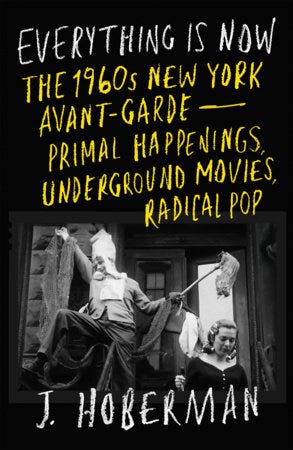
The mid-2020s can’t stop thinking about the 1960’s for some reason. This fall and winter I reviewed David Browne's Talkin in the Village, a thorough account of the '60s music scene, and I took down Like a Complete Unknown, which felt to me reductive and cartoonish—even though I couldn’t help but, because Dylan is such an incandescent songwriter, be moved by the music itself. J. Hoberman’s Everything Is Now: The 1960s New York Avant-Garde--Primal Happenings, Underground Movies, Radical Pop covers much of the same territory as Brown’s book, but moves out of the Village, roving manically, looking for anywhere where something happened or was literally a ‘happening.’